Why Are My Custom Food Labels Wrinkling During Application?
Discover why custom food labels wrinkle during application and how choosing the right label materials, adhesives, and application methods can help achieve smooth, professional results.
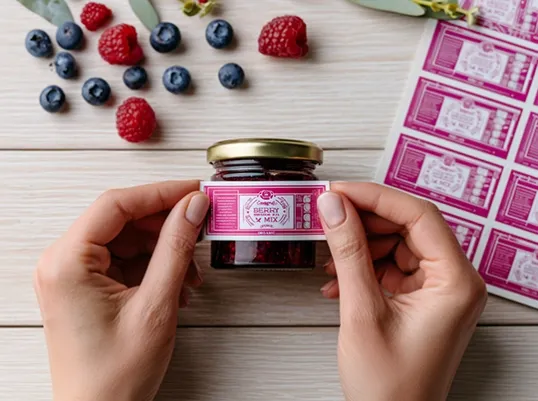
One of the most frustrating issues food manufacturers encounter is seeing perfectly printed labels wrinkle during application.
The artwork looks great. The print quality is excellent. The labels arrive exactly as expected. Yet once they are applied to the package, wrinkles begin to appear.
When this happens, many people naturally assume there's something wrong with the labels.
But from our experience, wrinkling is rarely caused by a single issue.
More often, it's the result of how the label material, adhesive, container shape, and application process work together.
This is why we spend so much time asking customers about their products before production begins.
Some customers wonder why we ask questions that seem unrelated to printing:
- What type of container are you using?
- Is it glass, PET, PP or PE?
- What's the diameter of the bottle?
- Will the labels be applied by hand or by machine?
- What environment will the product be stored in?
The reason is simple.
We're not just printing labels.
We're trying to make sure those labels perform perfectly after they're applied.
The Right Label Starts With Understanding the Container
One mistake many companies make is choosing label materials based only on appearance or price.
In reality, the container often determines which label construction will work best.
A flat glass jar and a small cylindrical bottle may look similar, but they place very different demands on a label.
Small-diameter containers are especially challenging.
As the label wraps around a tighter curve, the material needs enough flexibility to conform to the surface without creating stress.
If the material is too rigid, too thick, or paired with an unsuitable adhesive, wrinkles become much more likely.
This is why material selection is never just about choosing paper or film.
It's about matching the entire label construction to the packaging.
Every Packaging Shape Creates Different Challenges
Container shape is another factor that's often underestimated.
Not every package provides a perfectly flat labeling surface.
Common examples include:
- Round bottles
- Tapered containers
- Flexible packaging
- Small tubes
- Containers with seams or textured surfaces
These shapes change how the label contacts the package during application.
If the label is too large for the available flat surface, or if it's forced to conform to complex curves, wrinkles can easily develop.
This doesn't necessarily mean the label design is wrong.
It simply means the label solution should be developed specifically for that package.
The Application Process Matters Just As Much
Even when the label itself is correct, application can still create wrinkles.
For automatic labeling, factors such as:
- Label tension
- Roller pressure
- Application speed
- Label angle
- Conveyor synchronization
all influence how smoothly the label is applied.
If these settings aren't properly adjusted, the label may not release air evenly or may experience uneven tension during application.
As a result, wrinkles can appear even when the printed labels themselves are perfectly manufactured.
For hand application, the process is different.
The flexibility of the material and the initial tack of the adhesive become much more important because the operator is applying the label manually.
In both cases, the label and the application method need to work together.
One Customer's Experience Changed Everything
Not long ago, a customer from Canada contacted us because they were experiencing constant wrinkling and edge lifting on labels for their lip balm products.
Their previous supplier had printed the labels correctly, but the labels simply didn't perform well during application.
Instead of immediately recommending a new label, we first asked about the product.
What was the container made from?
How large was the diameter?
How were the labels applied?
Where would the products be stored?
After understanding the application, we recommended a different combination of label material and adhesive that was better suited to the container.
The result was exactly what the customer had been hoping for.
The wrinkles disappeared, the labels applied smoothly, and the edge lifting issue was resolved.
For us, this project reinforced an important lesson:
Sometimes solving the problem has very little to do with changing the artwork.
It starts with understanding how the label will actually be used.
A Professional Label Supplier Looks Beyond Printing
Many label issues can be prevented before production begins.
An experienced label manufacturer doesn't simply receive an artwork file and print it.
They look at the complete application.
- The packaging material
- The container shape
- The application method
- The storage environment
- The label material
- The adhesive system
When these elements are considered together, the risk of wrinkles, bubbling, or edge lifting becomes much lower.
That's why asking more questions at the beginning often saves customers much more time and money later.
Final Thoughts
Wrinkled labels are rarely caused by poor printing alone.
In most cases, they're the result of choosing a label solution that doesn't fully match the product and its application.
By understanding the container, selecting suitable materials and adhesives, and considering how the labels will actually be applied, many wrinkling problems can be avoided before production even starts.
A successful label isn't just one that looks beautiful.
It's one that continues looking beautiful after it's applied.
Need Help Choosing the Right Label Construction?
If you're experiencing label wrinkling, bubbling, or edge lifting, we'd be happy to review your project and recommend a suitable label solution before production.
Website: https://www.asiabees.com
Email: info@asiabees.com
WhatsApp: +86 173 3600 3921