
Jul 31, 2026Food Labels
How Can I Ensure My Custom Labels Work with a Labeling Machine?
Learn how to ensure your custom label rolls work with an automatic labeling machine by confirming the roll core size, label unwind direction, and maximum roll diameter before production.
As a product manufacturer or brand grows, its label printing and application requirements often change.
During the early stages of the business, the company may only need a relatively small quantity of digitally printed labels. Because the order volume is limited, applying the labels to products by hand may be a practical solution.
However, as the brand develops and production quantities increase, small-batch digital label printing and manual application may no longer be efficient enough.
The manufacturer may begin ordering larger quantities of flexographically printed labels and introduce a labeling machine to improve production efficiency.
At this stage, many manufacturers and brand owners have the same concerns:
What happens if the labels arrive but cannot be installed or dispensed correctly by the machine?
An experienced custom label manufacturer will normally consider these concerns before production. During the order confirmation process, the supplier should confirm several important label roll specifications with the customer.
1. Confirm the Label Roll Core Size
The first specification to confirm is the label roll core size.
The core is the cardboard or plastic tube in the center of the label roll. It must fit correctly onto the roll holder or unwind shaft of the labeling machine.
A 76 mm, or 3-inch, core is commonly used for machine-applied label rolls.
However, different labeling machines may have different requirements. Some machines may use another core diameter or require a specific adapter.
Before production, the label supplier may ask the customer to confirm:
- The labeling machine model
- The required label roll core diameter
- Whether the machine uses a special roll holder or adapter
Confirming the correct core size helps ensure that the finished label rolls can be installed properly on the labeling machine.
2. Confirm the Label Unwind Direction
The second important specification is the label unwind direction.
The unwind direction describes how the printed label is positioned as it comes off the roll.
Depending on the labeling machine, the top, bottom, left side, or right side of the printed artwork may need to come off the roll first.
If the unwind direction is incorrect, the label may feed into the machine in the wrong orientation. This may cause the label to be applied upside down or in the wrong direction on the product.
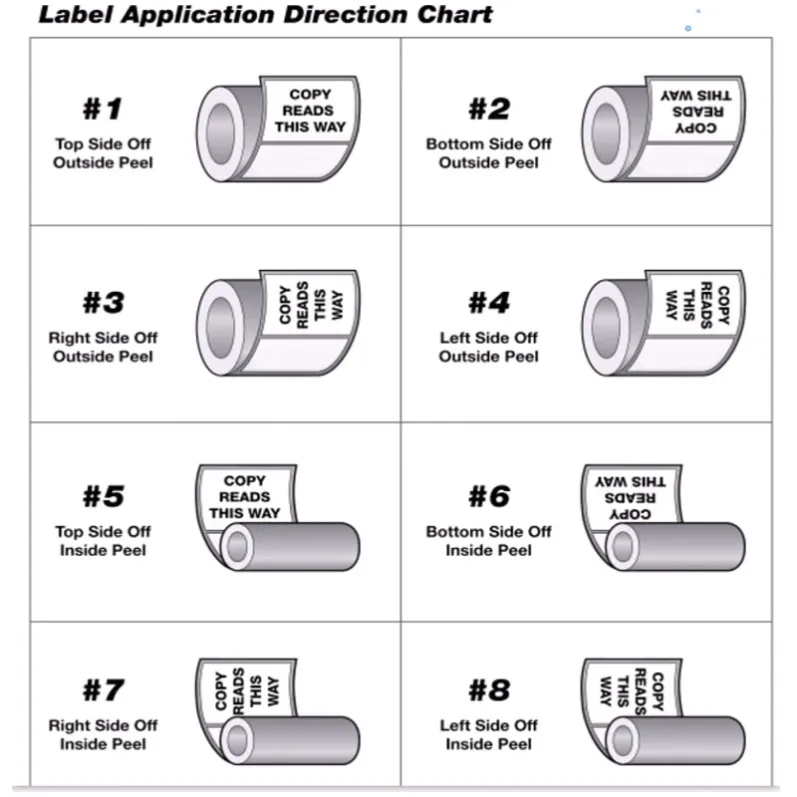
A professional label manufacturer will normally provide a label unwind direction chart showing the available options.
The customer can then select the option that matches the labeling machine.
When the correct unwind direction is unclear, the customer can check the machine manual, inspect an existing compatible label roll, or ask the labeling equipment supplier for confirmation.
3. Confirm the Maximum Label Roll Diameter
The third specification to confirm is the maximum label roll diameter, also called the maximum roll outer diameter or maximum roll OD.
Even when the core size and unwind direction are correct, a label roll may still be too large for the available space on the labeling machine.
Some manufacturers and contract product packers limit the maximum diameter of each label roll. This helps prevent the supplier from producing rolls that are too large to fit onto the machine.
Before production, the customer should tell the label manufacturer the largest roll diameter that the labeling equipment can accept.
The label supplier can then control the number of labels on each roll and divide the total order into a suitable number of rolls.
What Information Should You Give Your Label Supplier?
Before ordering custom labels for machine application, confirm the following three specifications:
- Label roll core size
- Label unwind direction
- Maximum label roll diameter
The safest approach is to provide the label supplier with the model or technical specifications of the labeling machine.
If the technical specifications are unavailable, photos of the machine and an existing compatible label roll may also help the supplier understand the required roll format.
Final Thoughts
Moving from hand-applied labels to machine labeling is a natural step for many growing manufacturers and product brands.
However, labels used for machine application must be produced in a roll format that matches the labeling equipment.
Confirming the label roll core size, unwind direction, and maximum roll diameter before production can greatly reduce the risk of receiving label rolls that cannot be used on the machine.
An experienced custom label supplier should confirm these details during the order process. Once the machine requirements are clearly understood, the labels can be manufactured in the correct roll format for efficient machine application.
Need Custom Labels for Machine Application?
If you are unsure about the correct roll core size, label unwind direction, or maximum roll diameter for your labeling machine, contact AsiaBees before placing your order.
Our team can help you confirm the correct label roll specifications for your machine application requirements.